
Enhancing Financial Digital Literacy in the V4: Building Digital Competencies for Financial Security
Despite advancements in digital finance within V4 countries, a substantial gap in financial digital literacy persists, increasing financial vulnerability and limiting the ability to use modern financial technologies, especially among young adults. Financial digital literacy involves safely using digital financial services like online banking, digital payments, budgeting tools, and understanding financial risks. However, educational frameworks in V4 countries often lag, resulting in disparities in financial security and digital inclusion. The project develops a practical, evidence-based framework to measure and improve financial digital literacy—the ability to navigate modern digital financial services, recognize manipulative content, and make safe, informed choices in online environments.
About the project
This project helps people in the V4 countries make safer and more informed financial decisions in the digital world. As online banking, payments, investing apps and financial information become part of everyday life, many users lack the practical skills needed to recognize risks, misinformation or manipulative practices. The project develops an open, university-based online platform with short, practical learning modules, simple tools and self-assessment features tailored to different age groups.
By combining data-driven analysis with hands-on digital education, the project strengthens financial digital skills, reduces vulnerability to scams, and supports inclusion and trust in modern financial services across the V4 region.
Quick facts
Project title: Enhancing Financial Digital Literacy in the V4
Tagline: Building Digital Competencies for Financial Security
Region: Czechia • Slovakia • Poland • Hungary
Implementation period: 01/02/2026–31/07/2027
News
🚀 Kick-off Meeting Successfully Held in Gdańsk
Date: April 17, 2026
Location: Gdańsk University of Technology, Poland
The project “Enhancing Financial Digital Literacy in the V4: Building Digital Competencies for Financial Security” officially started with its first kick-off working meeting held at the Gdańsk University of Technology.
The meeting brought together representatives from all partner institutions: Bratislava University of Economics and Business, Brno University of Technology, Gdańsk University of Technology, and Széchenyi István University.
Partners focused on defining tasks for the initial project phase, clarifying roles and responsibilities, setting up communication protocols, and preparing upcoming workshops and training activities.
The meeting concluded with agreed next steps and a shared understanding of how the partners will cooperate throughout the project implementation.
📄 More details in the official programme: View programme
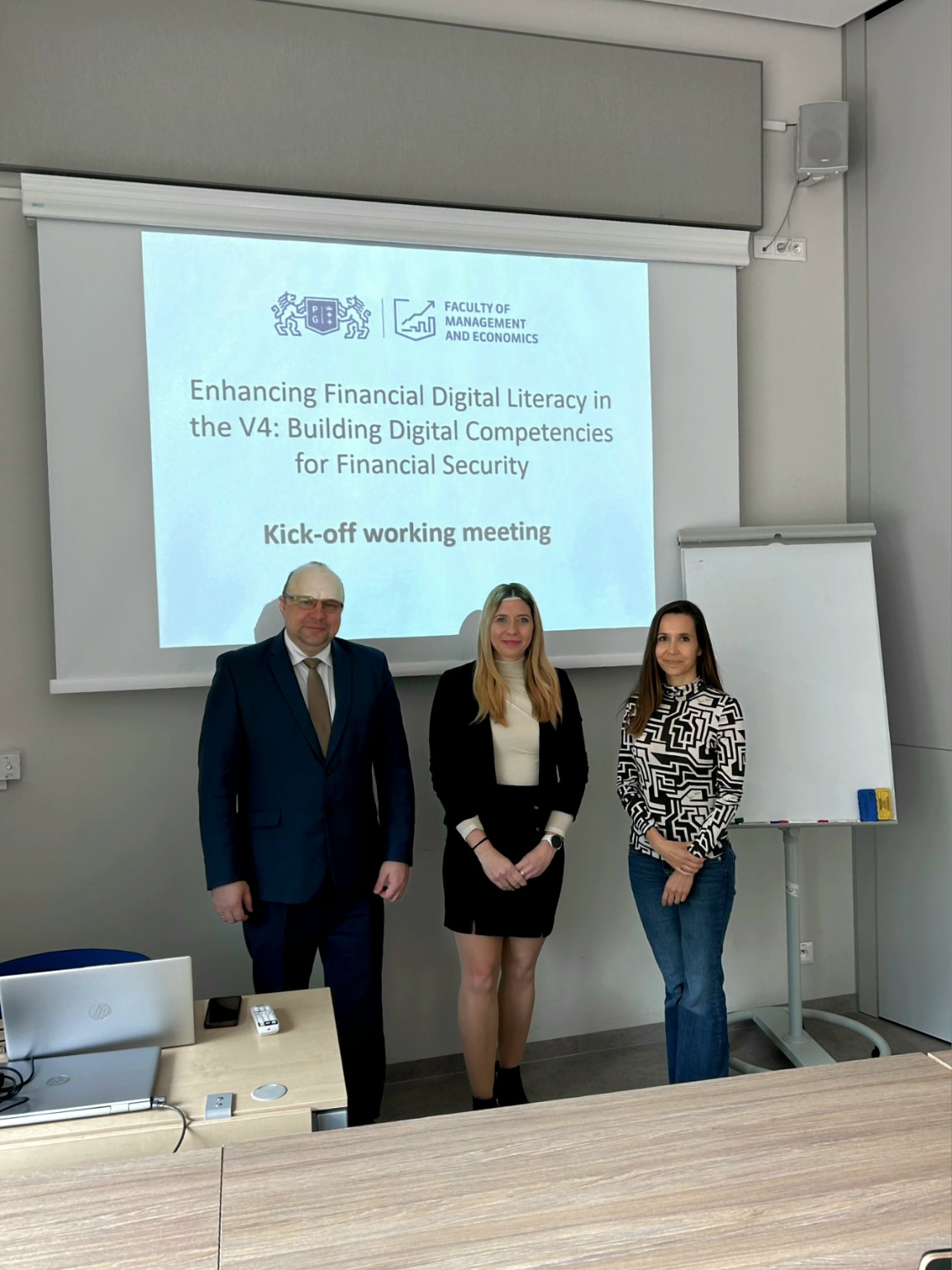
First in-person working meeting of the Visegrad project partners in Gdańsk.
Main objectives
- Improve financial digital literacy across the V4 through practical, easy-to-use learning tools.
- Develop a Financial Digital Literacy Index (FDLI) to measure skills, risks and gaps across countries and age groups.
- Engage students, educators and the wider public in building safe digital-finance habits.
- Create an open online platform with short modules, tools and self-assessment features.
Why it matters
- Poor financial-digital skills increase individual losses, exposure to scams and inefficient financial decisions.
- Better literacy improves consumer protection, trust and inclusion, especially for young and vulnerable groups.
- Comparable data (FDLI) enables evidence-based education and policy across the V4 region.
- Stronger financial-digital competencies support more stable, resilient and competitive economies.
Work packages (draft structure)
🔍 WP1 — Concept & Framework
Defines financial digital literacy in the V4 context and maps key risk channels in platform-based finance, including digital payments, online investing and misinformation.
📊 WP2 — Measurement & Index
Designs and validates a cross-country comparable Financial Digital Literacy Index (FDLI) and survey instruments to identify skill gaps across countries and age groups.
📈 WP3 — Data & Analytics
Applies modern, transparent analytics to understand risk exposure, behavioural patterns and decision-making in digital finance.
🎓 WP4 — Education Toolkit
Develops practical learning modules, case studies and exercises for universities, educators and the general public.
🌐 WP5 — Digital Platform
Implements a multilingual, university-hosted web platform for learning, self-assessment and dissemination of results.
📣 WP6 — Dissemination & Policy
Translates findings into actionable recommendations for educators, institutions and policy stakeholders across the V4.
Partner institutions
Official websites of all participating universities:
Funding acknowledgement

Contact
Project coordination: Silvia Komara, Bratislava University of Economics and Business
Email: silvia.komara@euba.sk
Address: Dolnozemská cesta 1a, Bratislava, 852 01, Slovakia